
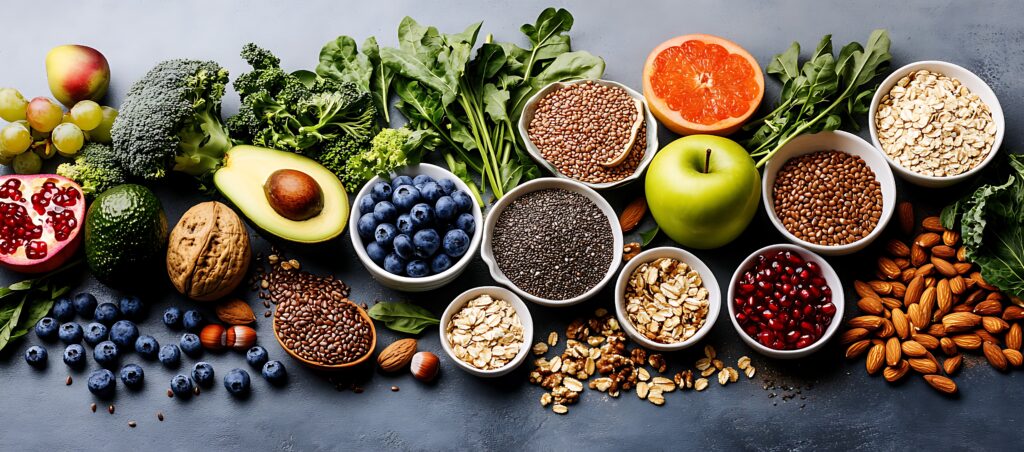
Most people know they should eat more fiber — but far fewer understand why fiber is one of the most powerful and versatile tools available for improving long-term health. From lowering cholesterol and balancing hormones to stabilizing blood sugar and supporting a healthy weight, the science behind dietary fiber is both robust and compelling. At Rocky Mountain Natural Medicine, we encourage our patients to think of fiber not as a diet afterthought but as a foundational pillar of their health. We want our patients to embrace the many dietary fiber health benefits.
Here is what the research actually says — and how you can start putting it to work today.
What are the health benefits of dietary fiber?
Dietary fiber is a type of carbohydrate found in plant foods that the human body cannot fully digest. Rather than being broken down and absorbed in the small intestine, fiber passes into the large intestine where it performs a wide array of functions — feeding beneficial gut bacteria, slowing the absorption of glucose, binding to cholesterol and excess hormones, and promoting regular bowel movements.
Fiber is broadly categorized into two types:
Soluble fiber dissolves in water to form a gel-like substance in the digestive tract. It is particularly effective at lowering cholesterol, stabilizing blood sugar, and promoting satiety. Good sources include oats, legumes, chia seeds, flaxseeds, apples, and psyllium.
Insoluble fiber does not dissolve in water and adds bulk to the stool, supporting digestive regularity and gut health. Good sources include vegetables, whole grains, and wheat bran.
Most fiber-rich foods contain a mix of both types — and both are important. The current recommended daily intake of fiber is 25 grams per day for women and 38 grams per day for men, yet the average American consumes only about half that amount.
Fiber and Cholesterol: A Well-Established Connection
One of the most thoroughly researched benefits of dietary fiber is its ability to reduce LDL (“bad”) cholesterol — a major risk factor for cardiovascular disease. The mechanism is straightforward: soluble fiber forms a viscous gel in the digestive tract that binds to bile acids, which are made from cholesterol. These bile acid-fiber complexes are then excreted in the stool rather than reabsorbed. To compensate, the liver must pull more cholesterol from the bloodstream to produce new bile acids — effectively lowering circulating LDL cholesterol.
A comprehensive meta-analysis published in Advances in Nutrition found that soluble fiber supplementation produced meaningful reductions in total cholesterol, LDL cholesterol, and serum triglycerides in adults. A landmark meta-analysis published in PLOS Medicine, encompassing 33 trials, found that increased fiber intake significantly reduced total cholesterol, LDL cholesterol, and triglycerides, while also lowering C-reactive protein — an inflammatory marker associated with cardiovascular risk. A 2023 systematic review published in the British Journal of Nutrition confirmed that viscous dietary fibers — the gel-forming soluble variety — were particularly effective at reducing LDL and non-HDL cholesterol compared to non-viscous fibers.
For patients looking to reduce cholesterol naturally, dietary fiber is one of the most well-supported and side-effect-free interventions available.
Fiber and Hormone Health: The Gut-Estrogen Connection
The relationship between dietary fiber and hormone health is one of the most fascinating and underappreciated areas of nutritional science — and one we pay close attention to at Rocky Mountain Natural Medicine.
Fiber supports hormone balance through its influence on the estrobolome — the collection of gut bacteria that regulate estrogen metabolism. The gut microbiome produces enzymes called beta-glucuronidases that deconjugate estrogen in the intestine, allowing it to be reabsorbed into circulation. When the gut microbiome is healthy and diverse — which is strongly supported by adequate fiber intake — this process is regulated appropriately. When the microbiome is disrupted (a condition known as dysbiosis), excess estrogen can be reactivated and recirculated, contributing to estrogen dominance, hormonal imbalances, PMS, PCOS, and other estrogen-related conditions.
Research published in the journal Molecular Nutrition & Food Research confirmed that the gut microbiome regulates estrogen metabolism through the estrobolome, and that alterations in gut microbial composition are associated with estrogen-related conditions including PCOS and endometrial cancer. A study published in PMC found that dietary fiber may increase the amount of estrogen excreted in the feces by inhibiting estrogen reabsorption in the intestines — effectively helping the body clear excess estrogen rather than recirculating it.
Flaxseeds deserve special mention in this context. They are rich in lignans — plant compounds that bind to estrogen receptors and help modulate estrogen activity, supporting a healthier hormonal balance. Ground flaxseeds are one of the most practical and accessible tools for daily hormone support.
For women navigating PMS, perimenopause, PCOS, or estrogen dominance, increasing dietary fiber — particularly from flaxseeds, legumes, and vegetables — is a meaningful and evidence-backed strategy.
Fiber, Blood Sugar, and Insulin Control
Dietary fiber is one of the most powerful dietary tools for managing blood sugar and improving insulin sensitivity — and the evidence base here is extensive.
Soluble fiber slows the rate at which glucose is absorbed from the digestive tract into the bloodstream. By creating a viscous barrier in the small intestine, it flattens the blood sugar spike that typically follows a carbohydrate-containing meal. Over time, this leads to more stable blood glucose levels, reduced insulin secretion, and improved insulin sensitivity.
A large meta-analysis published in PLOS Medicine found that higher fiber intake significantly reduced fasting plasma glucose, fasting insulin, HbA1c (a marker of long-term blood sugar control), and HOMA-IR (a measure of insulin resistance) compared to lower fiber diets. A 2024 systematic review published in Cureus confirmed significant improvements in glycemic markers and insulin sensitivity across multiple randomized controlled trials using dietary fiber interventions. Large prospective cohort studies consistently show that high dietary fiber intake — above 25 grams per day in women — is associated with a 20–30% reduced risk of developing type 2 diabetes, after adjusting for other factors.
This makes fiber a critical component of any approach to blood sugar management, insulin resistance, metabolic syndrome, and diabetes prevention.
Fiber and Weight Management
Fiber supports healthy weight in several interconnected ways. First, it promotes satiety — fiber-rich foods expand in the stomach, trigger the release of fullness hormones, and slow gastric emptying, all of which reduce overall food intake without requiring calorie counting. Second, fiber feeds beneficial gut bacteria that produce short-chain fatty acids (SCFAs) — compounds that play a key role in regulating fat metabolism and reducing inflammation. Third, high-fiber foods are naturally lower in caloric density, meaning you can eat a satisfying volume of food with fewer calories.
Research published in Frontiers in Nutrition found that fiber consumption promotes weight management by improving satiety, enhancing gut microbiota composition, and modulating fat metabolism. The PLOS Medicine meta-analysis referenced above also found meaningful reductions in body weight and BMI with higher fiber intake across 18 randomized controlled trials.
Importantly, the weight management benefits of fiber are not about restriction — they are about supporting your body’s natural hunger and fullness signals, reducing inflammatory drivers of weight gain, and optimizing the gut environment that underlies metabolic health.
How to Incorporate More Fiber Into Your Diet
Increasing your fiber intake does not have to be complicated. The goal is to add fiber-rich foods consistently throughout the day rather than in one large serving — which can cause digestive discomfort, especially if you are transitioning from a low-fiber diet. Increase gradually and drink plenty of water.
Here are some of our favorite practical sources:
Raspberries and blackberries are among the highest-fiber fruits available — with up to 8 grams of fiber per cup. They are also rich in antioxidants and low in sugar, making them an ideal daily addition to smoothies, yogurt, or oatmeal.
Artichoke hearts are an exceptional source of inulin — a prebiotic fiber that feeds beneficial gut bacteria. One cup provides nearly 9 grams of fiber and makes an easy addition to salads, grain bowls, or omelets.
Chia seeds provide approximately 10 grams of fiber per ounce, along with omega-3 fatty acids and lignans. Add to smoothies, overnight oats, or make a simple chia pudding.
Ground flax seeds are particularly valuable for hormone health due to their high lignan content, as described above. One to two tablespoons daily — added to smoothies, yogurt, or baked goods — is a simple and effective routine. Ground flax is more bioavailable than whole flax seeds.
Legumes — including lentils, black beans, chickpeas, and edamame — are among the most fiber-dense foods available, with 12–16 grams per cooked cup. They are also rich in plant-based protein, making them a powerful addition to any meal.
Carbonaut Gluten-Free Bread is a standout option for patients who avoid gluten — providing a meaningful amount of fiber per slice without the blood sugar spike of conventional bread.
Thorne FiberMend is a professional-grade fiber supplement containing partially hydrolyzed guar gum (PHGG) — a soluble, fermentable fiber with strong research support for gut health, blood sugar regulation, and cholesterol management. It mixes easily into water or smoothies with no grittiness, making it an ideal option for patients who struggle to meet their fiber needs through food alone.
How Much Fiber Do You Need?
The general recommendation is 25 grams per day for women and 38 grams per day for men — though many integrative and functional medicine practitioners find that patients thrive at the higher end of this range. If you are new to a high-fiber diet, start with an additional 5 grams per day and increase gradually over several weeks to allow your digestive system to adjust.
Signs you may need more fiber:
- Irregular bowel movements or constipation
- Blood sugar fluctuations or cravings after meals
- High LDL cholesterol
- Hormonal imbalances including PMS, PCOS, or estrogen dominance
- Difficulty maintaining a healthy weight
- Bloating or digestive discomfort after meals (paradoxically, this can indicate gut dysbiosis that fiber can help correct over time)
Working Fiber Into a Comprehensive Health Plan
At Rocky Mountain Natural Medicine we view dietary fiber as one component of a larger, individualized approach to health. Fiber is most powerful when paired with comprehensive hormone testing, gut health assessment, and a personalized nutritional plan tailored to your specific needs. If you are dealing with hormonal imbalances, blood sugar dysregulation, elevated cholesterol, or weight challenges, fiber is an important piece of the puzzle — but it works best alongside a thorough evaluation of your overall health picture.
We offer complimentary 15-minute consultations with all of our doctors. If you would like to explore how dietary fiber and other naturopathic strategies can support your health, we would love to talk.
References:
Ghavami A, et al. Soluble Fiber Supplementation and Serum Lipid Profile: A Systematic Review and Dose-Response Meta-Analysis of Randomized Controlled Trials. Advances in Nutrition. 2023;14(3):465–474. https://pmc.ncbi.nlm.nih.gov/articles/PMC10201678/Reynolds A, et al. Dietary fibre and whole grains in diabetes management: Systematic review and meta-analyses. PLOS Medicine. 2020. https://journals.plos.org/plosmedicine/article?id=10.1371/journal.pmed.1003053 Jovanovski E, et al. Are all fibres created equal with respect to lipid lowering? British Journal of Nutrition. 2023;129(7). https://www.cambridge.org/core/journals/british-journal-of-nutrition/article/are-all-fibres-created-equal-with-respect-to-lipid-loweringAlahmari A. Dietary fiber influence on overall health, with an emphasis on CVD, diabetes, obesity, colon cancer, and inflammation. Frontiers in Nutrition. 2024;11:1510564. https://pmc.ncbi.nlm.nih.gov/articles/PMC11671356/Fu L, et al. Associations between dietary fiber intake and cardiovascular risk factors: An umbrella review of meta-analyses of randomized controlled trials. Frontiers in Nutrition. 2022. https://www.frontiersin.org/journals/nutrition/articles/10.3389/fnut.2022.972399/fullKumari N, et al. From Gut to Hormones: Unraveling the Role of Gut Microbiota in (Phyto)Estrogen Modulation in Health and Disease. Molecular Nutrition & Food Research. 2024;68(6):e2300688. https://pubmed.ncbi.nlm.nih.gov/38342595/Frugé AD, et al. Associations between Dietary Fiber, the Fecal Microbiota and Estrogen Metabolism in Postmenopausal Women with Breast Cancer. PMC. 2021. https://pmc.ncbi.nlm.nih.gov/articles/PMC7875566/Zeng Y, et al. Effects of Dietary Fiber on Glycemic Control and Insulin Sensitivity in Patients with Type 2 Diabetes: A Systematic Review and Meta-analysis. ScienceDirect. 2021. https://www.sciencedirect.com/science/article/pii/S1756464621001493Ojo O, et al. Effects of Dietary Fiber Interventions on Glycemic Control and Weight Management in Diabetes: A Systematic Review of Randomized Controlled Trials. Cureus. 2025. https://www.cureus.com/articles/338215Weickert MO, Pfeiffer AFH. Impact of Dietary Fiber Consumption on Insulin Resistance and the Prevention of Type 2 Diabetes. PubMed. 2018. https://pubmed.ncbi.nlm.nih.gov/29378044/Dahl WJ, Stewart ML. Effects of Dietary Fiber and Its Components on Metabolic Health. PMC. 2015. https://pmc.ncbi.nlm.nih.gov/articles/PMC3257631/Fu J, et al. Dietary Fiber Intake and Gut Microbiota in Human Health. PMC. 2022. https://pmc.ncbi.nlm.nih.gov/articles/PMC9787832/Fiber, Lipids, and Coronary Heart Disease. Circulation / American Heart Association. 1997. https://www.ahajournals.org/doi/full/10.1161/01.cir.95.12.2701Mayo Clinic. Dietary Fiber: Essential for a Healthy Diet. https://www.mayoclinic.org/healthy-lifestyle/nutrition-and-healthy-eating/in-depth/fiber/art-20043983